Tacklit Insights

Making sense of mental health software: PMS, EHR, CMS, and the rise of the Care Delivery Platform
Confused by PMS, EHR and CMS? A plain-English guide to mental health software, and the new category replacing all three.

Healthcare software is full of acronyms. Practice management systems (PMS), electronic health records (EHR), case management systems (CMS). Each was created some time ago to solve a particular problem for a particular part of the healthcare organisation, and each has its uses and its shortcomings. For a leader trying to choose a software system that enables better access and quality of care, the labels create more confusion than clarity.
This article makes sense of these categories in plain terms. It then introduces a newer category, the care delivery platform, of which Tacklit is a leading example. A care delivery platform delivers on the use cases of all three legacy categories and much more, which is why it is steadily gaining adoption across mental health services.
The three legacy categories
A practice management system is built around the needs of the receptionist. Its job is to get people booked in and to get the work paid for. It runs the calendar, takes bookings, sends reminders, raises invoices, and handles claiming. It keeps a busy diary moving and the money flowing, but it was never designed to hold clinical information or deliver a care pathway.
An electronic health record is the filing cabinet. Its purpose is to hold the clinical truth about a patient. It stores notes, assessments, diagnoses and medications, supports prescribing, and allows that information to be shared safely with other parts of the health system. Clinicians rely on it to be the record of care, but it does little to bring clients through the door or to run a health program.
A case management system is the program coordinator. It is built for organisations delivering funded or community care, where the challenge is managing who is eligible for what, tracking budgets and goals against funding, coordinating a distributed workforce, and reporting back to the funder. It handles the operational and funding machinery, but it is lighter on clinical depth and a no show on the experience of the person receiving care.
Where these systems fall short
Each of these systems does its job. The difficulty is that a modern mental health service needs all of those jobs done together, and the legacy categories were never designed for that. Five limitations come up again and again.
They are not built with the person receiving care in mind. Each system is designed for a different worker inside the provider, the receptionist, the clinician, the case coordinator, rather than for the client. The result is felt by the people the service exists to help. Booking or rescheduling an appointment is harder than it should be. Seeing your own health information, your plan, or your case progress is often impossible. The person at the centre of care is treated as an afterthought.
They cover one piece of the journey, not the whole thing. Each was built for a single stage, so a service that wants to support someone from first enquiry through to discharge has to run several systems at once. Information is re-keyed between them, data sits in silos that never quite reconcile, and staff hold the gaps together with spreadsheets and manual workarounds. The cost is inefficiency, reporting that takes days to assemble, and less time available for actually delivering care.
They cannot measure the journey end to end. Because each system only sees part of the experience, none can tell you whether people are genuinely getting better. The legacy categories were not designed to schedule and score standardised outcome measures over time, track recovery across an entire episode of care, flag clients who may be deteriorating, or link clinical, engagement and funding data into a single view. That whole layer of measurement, which is where quality improvement actually comes from, falls through the cracks between systems.
They are generic. Most of these products were built for any kind of healthcare setting, and some were built for industries well beyond health. For example, it is not unusual to find a case management system originally designed for financial services being used to manage clients in a health setting. Generic tools can be made to work, but they miss the chance to fit the way a mental health workforce really operates and the way clients really engage, and with it the chance to improve both quality and access to care.
They were not built for AI. These systems came of age before modern AI, so intelligence and automation were never part of their foundations. Organisations can still capture some benefit by adding a standalone AI scribe, or by lightly integrating a scribe with their existing system. However, a bolt-on scribe cannot reach into the clinical record and it sits outside the workflow. So it can draft a note but cannot act on a referral, trigger the next step in a care pathway, or surface a risk in context. When AI is an afterthought to an older platform, or a separate tool stitched across several systems, its value is always capped. The benefit of AI depends on how deeply it is embedded in the work, and these categories were never designed to embed it at all.
What a care delivery platform changes
Care delivery platforms are an emerging category built specifically to solve these limitations. The premise is different. Instead of automating one stage of the journey and leaving you to connect the rest, a care delivery platform treats the whole journey as one connected system.
In practice this means the platform covers everything the three legacy categories do. Tacklit delivers the practice management functions of booking, scheduling, invoicing and claiming, the electronic health record functions of clinical notes, assessments, care planning and risk management, and the case management functions of referral intake, triage, caseloads, care episodes, funding and funder reporting. All of it works from a single client record, so information entered once is available everywhere.
It then solves the five limitations directly. The person receiving care is designed in from the start, with a client portal and digital front door that make it easy to book, reschedule, complete forms and assessments, and stay informed. The journey is connected end to end, removing the silos, the re-keying and the spreadsheet workarounds. Measurement runs across the whole episode, so leaders can see access, outcomes, utilisation and risk in one place. And because the platform is built for mental health rather than adapted from a generic tool, it supports sector-specific functionality, including measurement based care, early intervention, blended care, a lived experience and peer workforce, and clinical supervision. AI is native rather than bolted on, so it works with full context of the clinical record and inside the workflow, drafting notes, processing referrals, summarising sessions and flagging risk, which is the difference between a scribe that types for you and intelligence that helps run the service. Underlying all of it is a simple belief. Humans are best placed to care for humans, and technology should amplify their impact rather than replace them.
Functionality Comparison
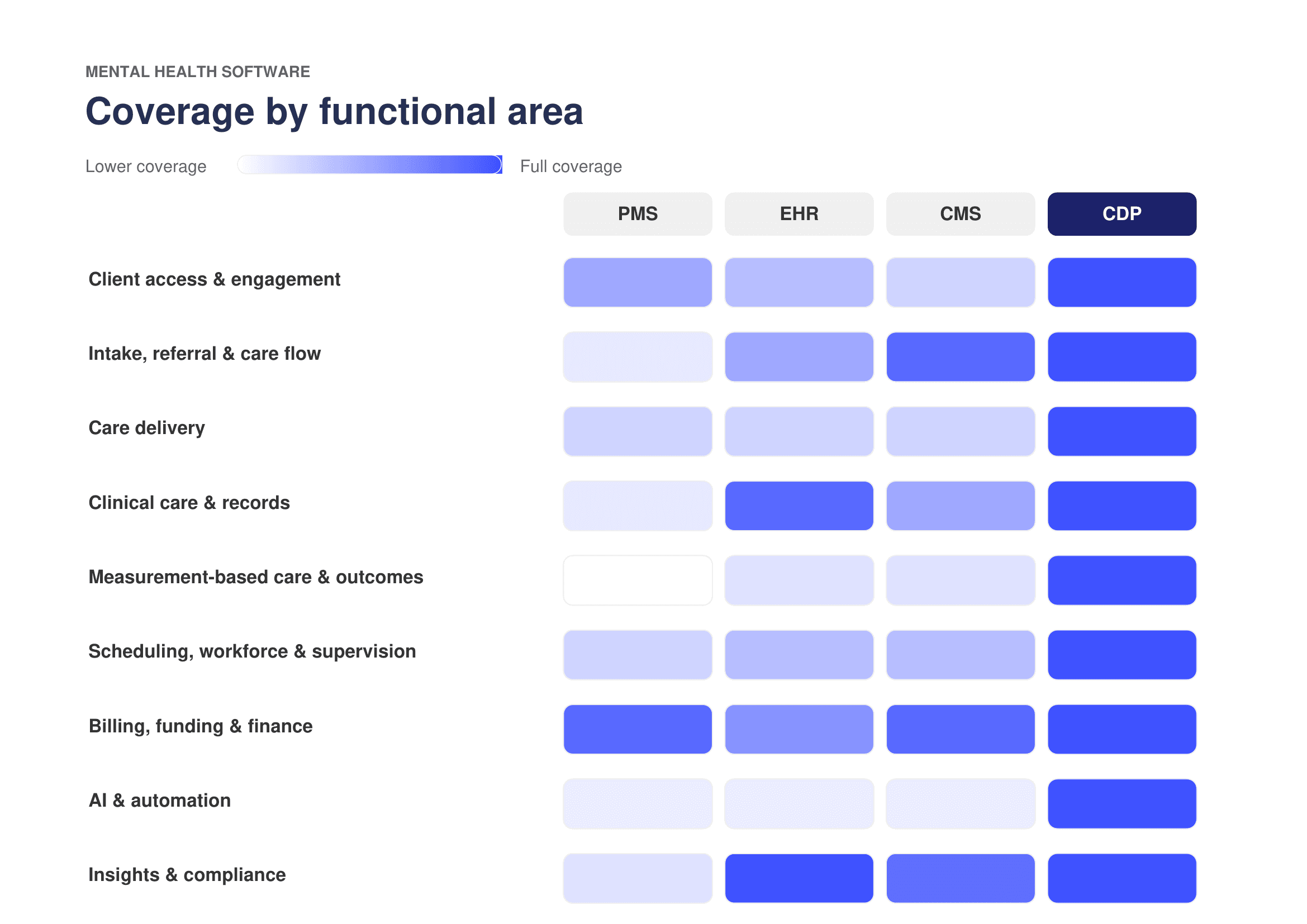
Seen side by side in the picture below, the pattern is clear. A practice management system is strong at the front desk and billing. An electronic health record is strong at the clinical record and compliance. A case management system is strong at running a funded program. Each lights up one part of the map and leaves the rest faint. A care delivery platform covers all of those areas, and adds the capabilities for measurement, engagement and AI that the others were never built to provide. It is the only category designed to span the whole journey.
Conclusion
A growing number of mental health service delivery organisations are rethinking their software. The realisation is often that they are better off moving away from systems that are generic, that solve only part of their needs, and that treat the person receiving care as an afterthought. Care delivery platforms, such as Tacklit, are emerging as the platform of choice for leading organisations.
Common questions
Is Tacklit a practice management system for mental health? Yes. Tacklit provides best of breed practice management for mental health services, including scheduling, online bookings, a digital front door, invoicing, payments, and claiming, all within one platform.
Is Tacklit an electronic health record or EMR for mental health? Yes. Tacklit is a full mental health electronic health record, covering clinical notes, assessments and psychometrics, letters and reports, care planning and risk management, structured around care episodes from referral to discharge.
Is Tacklit a case management system for mental health? Yes. Tacklit delivers mental health case management, including referral intake and triage, waitlist and caseload management, care episodes and packages, budget and funding tracking, and funder and statutory reporting.
What is a care delivery platform, and how does Tacklit fit? A care delivery platform is a single system that performs the work of a practice management system, an electronic health record and a case management system, and adds capabilities built specifically for mental health, including measurement based care, blended and group care, a lived experience workforce, clinical supervision, and responsible AI. Tacklit is a leading care delivery platform for mental and behavioural health, and is considered a best of breed mental health PMS, EHR and CMS in its own right.
Recent Posts