Community mental health is complex. Your software shouldn't be.
Referrals, waitlists, multidisciplinary care and funder reporting in one system. Built for community mental health teams, peer workforces and the contracts that fund them.
5,000+
clinicians
300,000+
active clients
6x
average ROI

Care delivery made easier anywhere, anytime
What does Tacklit do for a community service?
Tacklit gives a community mental health service one system for the whole pathway: custom referral forms into a single triage inbox, an ordered waitlist that fills openings automatically, episodes of care per program so each contract reports on what it funded, one record shared by clinicians, care coordinators and peer workers with role-based access, and funder, board and commissioner reporting from live data.
✓
One referral inbox, with AI parsing incoming referrals
✓
Ordered waitlist with automatic slot offers
✓
Episodes per service, so contracts report cleanly
✓
Peer workforce on the same record, not a workaround
✓
Services report and dashboards from live data
✓
Connected workspaces for multi-site organisations
Key facts
Built for
Community mental health teams, peer workforces and multi-program providers
Blocks usually added
Referral + Waitlist, Lived Experience Workforce, Analytics, Advanced
Reporting
AU: PHN and state contract reporting. UK: commissioner and NHS reporting
In use at
Caraniche and Swindon & Gloucestershire Mind, among others
Getting started
Talk directly to our founders. No demo script
Why is the tooling always a patchwork?
You're accountable for outcomes across a whole community. The system should help you see them.
You're running high caseloads across multiple programs, sites and funding contracts, and the tooling is a patchwork: a referral inbox that's actually a shared email account, a waitlist that's actually a spreadsheet, and a client management system that was designed for a GP clinic and shows it.
Risk information lives in free text where nobody can see it at a glance. Your peer workforce is forced into clinical templates that don't fit how they work. And every reporting period, someone loses a week rebuilding the numbers your funder wants from exports that never quite reconcile.
From referral to reporting, in one place
Referral + Waitlist
AI
A front door that doesn't leak
Custom referral forms capture exactly what each pathway needs, every referral lands in one inbox for triage, and AI referral parsing reads incoming referrals and extracts the structured detail so your intake team isn't retyping faxes.
UK: this is the workflow NHS-funded and commissioned services use for their referral pathways.
Referral + Waitlist
A waitlist you can defend
An ordered, visible waitlist with openings filled from it. Open and cancelled slots can be offered to waiting clients automatically, so capacity never sits idle while someone waits.
Lived Experience Workforce
Care that fits a multidisciplinary team
Clinicians, care coordinators and peer workers share one record, each with role-based access. Peer workers get profiles and note formats built for their role, on the same record as the clinical team, because shared care only works when everyone can actually share.
Base
Episodes, not endless files
Each client holds an episode per service with its own lifecycle, so a client supported by two programs at once has two clean episodes, and your reporting reflects what each contract actually funded.
Analytics
Reporting your funders recognise
The services report gives you the numbers funders and boards expect, from live data. In-platform dashboards show what's working across the service, and government and commissioner-required reporting comes from the same source.
AU: PHN and state contract reporting. UK: commissioner and NHS reporting.
Advanced
Multi-site, one organisation
Connected workspaces run several teams or locations under one structure, with advanced permissions and custom roles matched to how your organisation actually works.
Is this your service?
Tick everything that sounds like your service. We'll show you what changes.
Inside the product
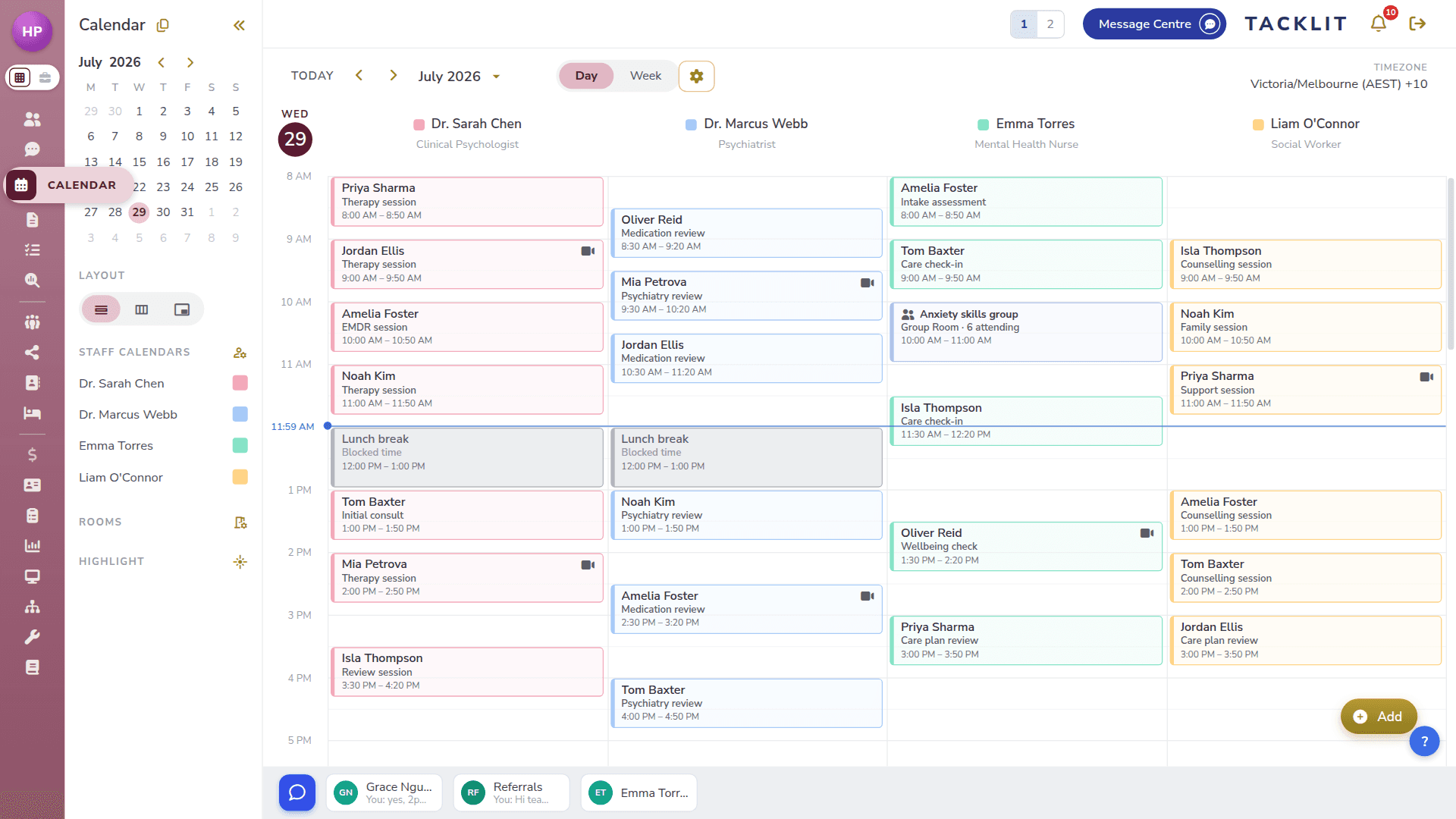

Funder confidence comes from data you can stand behind
Community services live and die on funder confidence. Tacklit was built for mental health from day one, shaped by lived experience, and priced so you take only the blocks you need.
Services like Caraniche and Swindon & Gloucestershire Mind run on it.
6x
average customer ROI
Included
Base clinical core

Community mental health software: common questions
Our statuses and workflows are specific to our contracts. Can Tacklit match them?
Yes. Episode statuses, closure reasons, triage routing, escalation paths and automations are configured per workspace, so the system follows your model of care rather than the other way round.
Can we report differently for different funders?
Yes. Episodes are tracked per service, so activity and outcomes can be reported against the contract that funded them. Dashboards and services reports draw on live data, and a data pipeline or PowerBI can feed your own analysts.
We employ peer workers. Is that actually supported or just possible?
Actually supported. Peer worker profiles, lived-experience note formats, shared care coordination and role-based access are a dedicated block, not a workaround.
Tell us what your contracts ask for
Talk directly to our founders — no demo script. We'll show you exactly how a community service runs on Tacklit.
Start a conversation