
Tacklit Insights

AI in Crisis Helplines: Balancing Opportunity, Risk and Responsibility
Highlights from the panel hosted by the International Association for Suicide Prevention

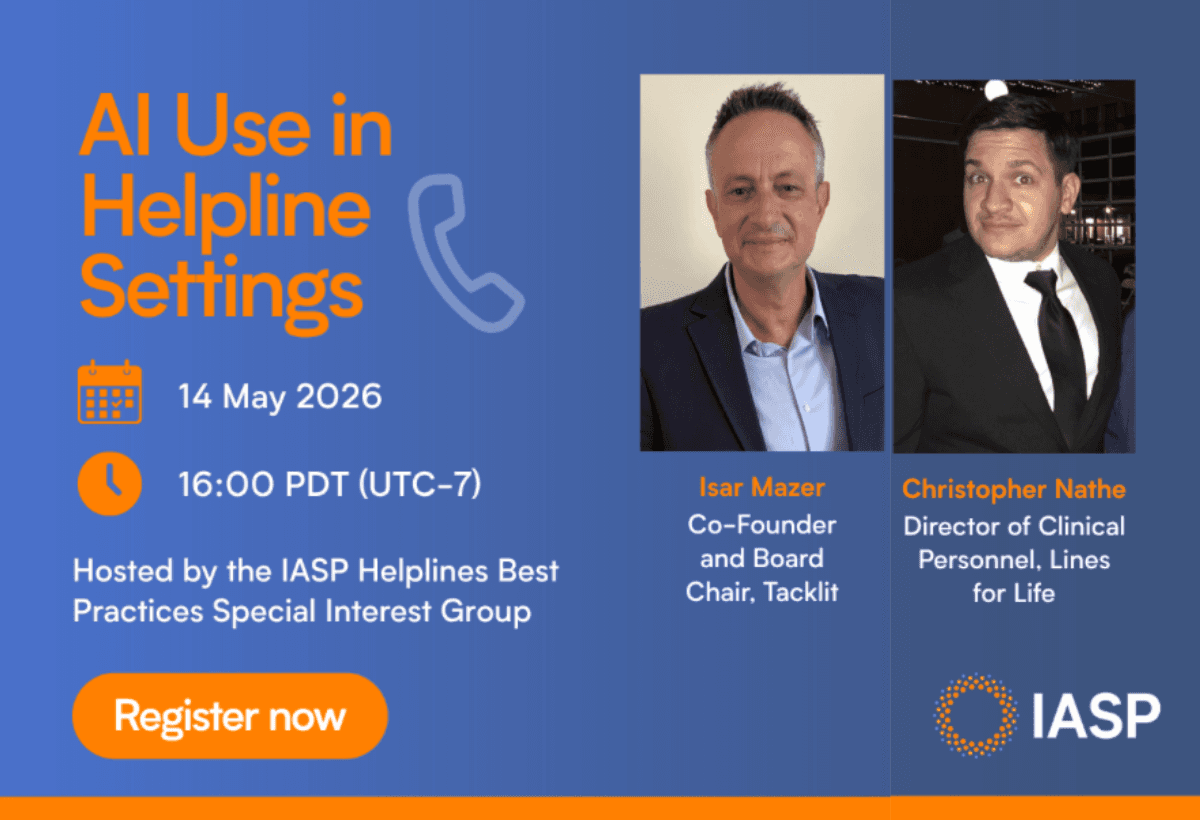
At a recent webinar hosted by the International Association for Suicide Prevention (IASP), leaders from across the global crisis support community came together to discuss one of the most important questions currently facing the sector: what role should artificial intelligence play in improving services?
The panel, moderated by Thilini Perera, CEO of Lifeline International, brought together two people and organisations approaching the topic from complementary perspectives:
Isar Mazer, Co-Founder and Chair of Tacklit, a leading end-to-end delivery platform for mental health services
Chris Nathe, Director of Clinical Personnel at Lines for Life, one of the leading crisis support and suicide prevention organisations in the United States
Lines for Life is operates a broad range of crisis support, suicide prevention and substance use services across the state of Oregon, USA. In addition to the 988 line, the organisation runs dedicated helplines for youth, veterans and military families, substance use support, senior loneliness, and other community-specific services. The organisation also delivers prevention programs, workforce training, policy advocacy and community education initiatives.
While the webinar covered a broad range of topics, a clear theme emerged throughout the session: AI presents a significant opportunity to improve access to support and strengthen service delivery, but only if implemented thoughtfully, safely and with the right governance.
Why the sector cannot ignore AI
Both speakers agreed that the mental health and crisis support sectors are facing extraordinary demand pressures.
Across countries, demand for mental health support continues to grow rapidly while workforce shortages remain severe. The panel highlighted the growing mismatch between demand for mental health support and the sector’s collective ability to meet it, with workforce shortages and rising waitlists now common challenges across many countries.
Against that backdrop, both panellists argued that the sector has a responsibility to explore technologies that may help increase access and improve service capacity.
As Isar Mazer noted during the discussion:
“The need is just so high and so much higher than our collective ability to support people, that I think we all have an obligation to think deeply about how technology and AI can improve access and quality.”
Chris Nathe shared a similar perspective from the crisis line environment, where increasing call demand, workforce pressure and volunteer support requirements are creating operational strain across services.
Importantly, neither speaker framed AI as a replacement for human care. Instead, the discussion focused on how AI may strengthen human-led support systems, reduce administrative burden and help services scale safely.
Significant opportunity, but also significant risk
A second area of strong alignment between the speakers was the need for caution.
While debate often focuses on the prospect of AI replacing therapists or crisis workers, both speakers emphasised that there are meaningful risks associated with unsupervised AI interacting directly with vulnerable individuals. Isar summarised the challenge simply:
“There’s enormous opportunity here, but there are also risks we need to take very seriously. The question is not whether AI is good or bad. The question is how we apply it responsibly.”
Chris Nathe echoed that sentiment, noting that trust is fundamental in crisis support settings and that organisations must ensure technology is implemented in ways that strengthen rather than undermine safety and quality.
“In crisis services, trust and safety have to remain at the centre of every technology decision we make.”
A framework for assessing AI risk in mental health services
One of the central contributions from Tacklit during the panel was a practical framework for assessing AI opportunities according to both risk and potential return.
Rather than viewing AI as a single category, Tacklit’s framework encourages leaders to think about different types of AI use cases and the varying levels of risk associated with each.
The framework discussed during the session considers three core questions:
Is the AI consumer-facing?
Is the AI supervised by humans?
How severe is the condition of the person receiving support?
From this perspective, lower-risk AI opportunities tend to involve non-consumer-facing workflows, human-supervised support, and operational augmentation rather than autonomous care delivery. Higher-risk scenarios involve unsupervised AI interacting directly with people in distress.
The framework also encourages leaders to consider return alongside risk. In many cases, some of the most valuable near-term opportunities involve saving frontline staff time, reducing administrative burden and improving operational efficiency, all of which can be achieved at acceptable levels of risk.
This distinction became particularly relevant as Chris Nathe shared the practical AI initiatives currently underway at Lines for Life.
How Lines for Life is using AI today
A key strength of the webinar was the focus on practical implementation.
Chris Nathe shared several examples of how Lines for Life is already using AI to support workforce capability and operational effectiveness. These examples aligned with the lower-risk categories discussed by Tacklit, as they focused on enabling staff and improving operations rather than unsupervised AI interacting directly with people in crisis.
Recruiting and hiring simulations: Lines for Life is using AI to help assess and prepare prospective crisis workers through simulated interactions and assessment scenarios. This allows the organisation to evaluate communication skills, judgement and readiness in a more scalable and consistent way, while also helping candidates better understand the realities of crisis support work.
Training and workforce development: AI is being explored as a tool to support staff training and ongoing capability development. Chris discussed how AI can help create more personalised and responsive learning environments for frontline workers, supporting skill development at scale across large and distributed teams.
Quality assurance and feedback: Lines for Life is also using AI to assist with quality assurance processes, including reviewing interactions and helping supervisors provide more consistent and timely feedback to staff and volunteers. The goal is to strengthen quality and support continuous improvement, while retaining human oversight.
Data utilisation, reporting and insights: Chris also spoke about the potential for AI to help organisations better utilise the large volumes of operational and service data generated by crisis lines. AI-supported reporting and insight generation can help identify trends, improve decision making and support service planning and improvement initiatives.
As Chris explained:
“Some of the most valuable AI opportunities today are not replacing human connection, but supporting the people delivering that connection every day.”
Building the ‘enablement layer’ for AI
Beyond specific AI use cases, another theme of the discussion was the importance of what Tacklit refers to as the AI “enablement fabric”. Successful AI adoption depends not only on the individual use cases pursued, but also on the broader systems, governance structures and organisational foundations that sit underneath them.
This includes, integrated systems and high-quality data, governance and ethics frameworks, privacy and security controls, implementation capability, and trusted vendor partnerships
Both speakers also discussed the importance of organisational alignment and mission orientation when selecting technology partners. Chris Nathe reflected on the importance of working with vendors that understand the realities and responsibilities of crisis support work, rather than treating mental health as simply another software category.
Similarly, Isar spoke about Tacklit’s origins and long-term focus on mental healthcare.
“Tacklit was built specifically for mental health services. Our view has always been that this sector deserves technology partners who deeply understand both the operational complexity and the responsibility involved.”
This emphasis on mission-aligned partnerships resonated strongly throughout the conversation.
A balanced path forward
One of the most valuable aspects of the webinar was its balanced perspective.
There was broad agreement that AI should not be approached as a replacement for human crisis support. Equally, there was recognition that the sector cannot afford to ignore technologies that may help improve access, workforce capability and service quality.
As demand for mental health and crisis support services continues to rise globally, the session highlighted that responsible implementation will determine whether AI becomes a meaningful force for good in the sector.
Recent Posts